Information as strategic infrastructure
Organizations execute coherently only when decisions, information, and systems follow the same underlying cycle.
How to align strategy, tactics, and operations through a single, verifiable information flow.
Information should be infrastructure, not an afterthought
Insight: Information should be infrastructure, not an afterthought.
When information becomes infrastructure, decisions stop being isolated events and become natural consequences of a single flow that connects intent, prioritization, and execution.
Most organizations still treat data as fields to be “filled in”, not as the backbone that holds strategy, tactics, and operations together. Each area builds its own board: different metrics, conflicting truths, misaligned timelines. Strategy speaks one language, operations speak another, and the tactical layer spends its time translating conflicts. When information is designed as strategic infrastructure, the decision → data → system flow follows the same logic across all levels. Friction decreases, priorities become visible, and predictability shifts from aspiration to routine.
This happens because fragmented information creates fragmented decisions — and fragmented decisions produce incoherent execution.
In one minute
- Organizations execute coherently only when decisions, information, and systems follow the same cycle.
- Without a shared information model, every strategic shift becomes manual reconciliation instead of a rule change.
- Start by mapping one critical decision end-to-end: intent → indicators → systems → rituals.
Multiple “truths” create translation work
Each area builds its own dashboard and cadence. Metrics diverge, timelines drift, and the tactical layer becomes a translation service between conflicting versions of reality.
When information is designed as infrastructure, the organization moves from arguing about numbers to choosing bets — because the flow is shared and verifiable.
A reference model makes alignment explicit
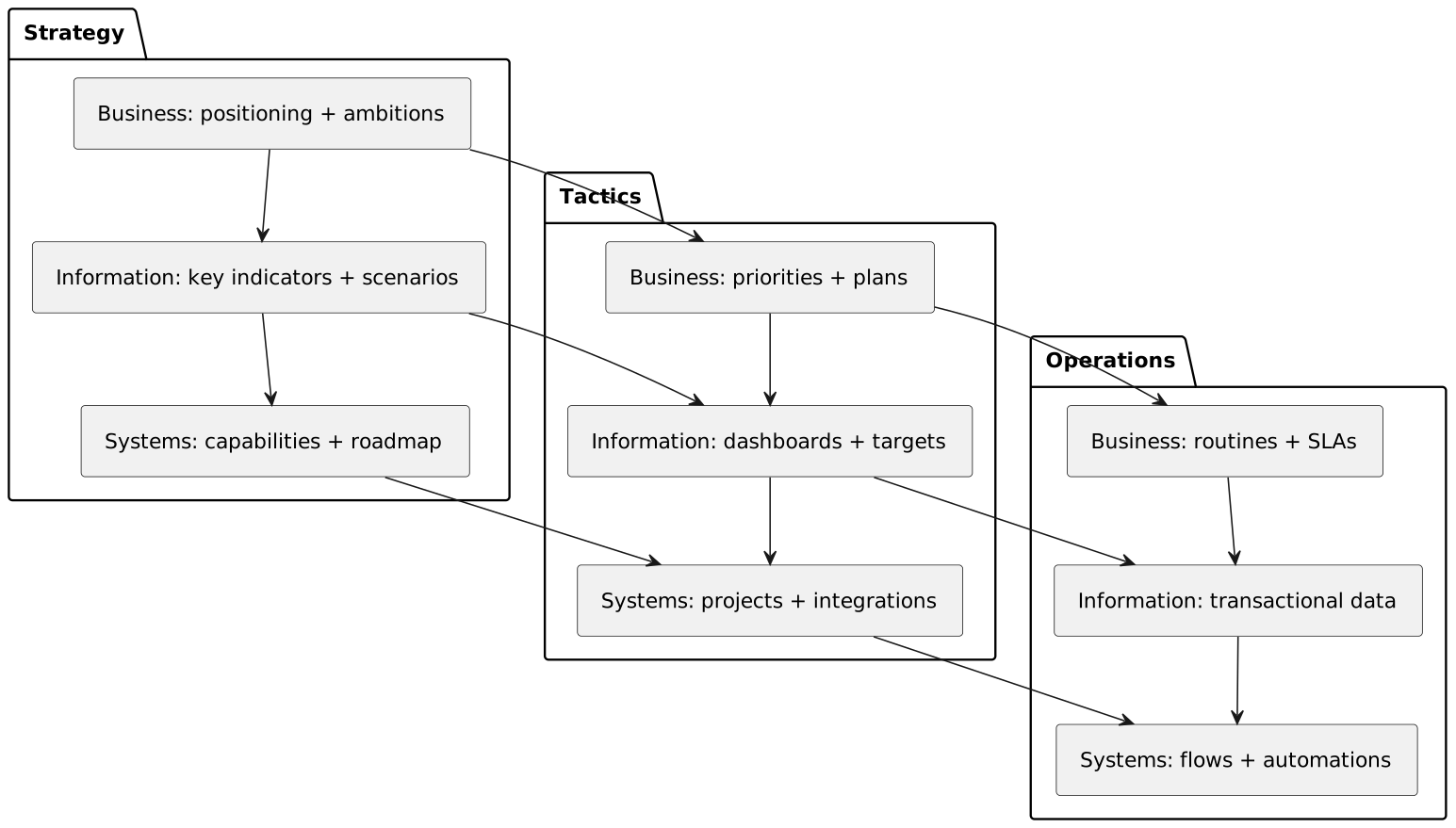
Reference model (levels × axes). Levels: strategy → tactics → operations. Axes: business → information → systems.
| business | information | systems | |
|---|---|---|---|
| strategy | positioning and ambitions | key indicators and scenarios | capabilities and roadmap |
| tactics | priorities and plans | dashboards and quarterly targets | projects and integrations |
| operations | routines and SLAs | transactional data | flows and automations |
Strategy often starts as slides, not as an information model; the result is a narrative that does not translate into fields, events, and concrete routines. Each area defines its own metrics and cadences, creating multiple competing “versions of the truth”. Systems are implemented for operational convenience, not to reflect the real path of critical decisions through the organization.
Most importantly, the information cycle (how data is created, consolidated, and used as evidence) is rarely designed; it simply emerges from old habits and ad‑hoc integrations. Without a single cycle, every strategic shift requires “convincing” teams and manually redoing reports, instead of adjusting the rules that govern the flow of information.
This is less urgent when decisions are local and feedback loops are short. It becomes critical when multiple teams depend on shared evidence and the cost of reconciling “truth” slows down execution.
Where the information cycle is broken
Look for signals where decisions change but information doesn’t, where tactical work runs on urgency, and where systems create parallel records.
Strategy. Strategic decisions change, but the information used remains static. The strategic cycle is not connected to the information cycle. A good first move is to map critical decisions and identify the minimum information, sources, and cadences needed to support them.
Tactics. Tactical teams operate based on urgency rather than evidence. Tactical information does not arrive at the right time or is not trusted. A practical way to start is to define clear routines for updating, reconciling, and synchronizing information between intermediate areas, with explicit owners for “information health”.
Systems. Systems do not reflect the strategy → tactics → operations flow. The technology architecture does not match the decision logic. One simple move is to adjust flows and integrations to follow the full decision cycle, avoiding parallel records, hidden spreadsheets, and automations that bypass the reference model.
Design one shared information flow
Suggested moves — pick one to try for 1–2 weeks, then review what you learned.
Map the decision → information cycle
Design the organization’s information cycle: which critical decisions exist, who makes them, based on which information, and at what frequency. This matters because if decisions don’t have an information spine, teams will create competing truths to move. Start by picking one critical decision and mapping it end‑to‑end (owner, indicators, sources, cadence). Watch for less “manual reconciliation” work after strategic shifts.
Make information health a responsibility (with rituals)
Define routines for updating, reconciling, and synchronizing information, with explicit owners for information health. This matters because without ownership and cadence, the flow decays and intuition fills the gaps. Start by adding one weekly ritual: update indicators, reconcile conflicts, and publish the shared view. Watch for fewer meetings arguing about “the right number”.
Reinforce the flow in systems (and set readiness criteria)
Adjust integrations, automations, and dashboards to reinforce the strategy → tactics → operations flow, and set readiness criteria (no strategic decision without traceable indicators). This works because if systems allow parallel records, the organization will build them under pressure. Start by identifying one hidden spreadsheet and replacing it with a traceable source in the system. Watch more decisions made from a single shared flow — and fewer surprises in operations.
It matters even more when strategy is explicit enough that you can describe the value you want to optimize.
Strategic information is not about volume — it is about ensuring that every important decision reliably reaches the same set of evidence at any level of the organization. Coherence is what turns scattered data into infrastructure capable of sustaining long‑term ambition.
If we ignore this, strategy gradually loses contact with reality and becomes a narrative that needs to be constantly “sold” internally. Tactical teams spend their energy reconciling numbers instead of orchestrating coordinated moves across areas.
Which critical decisions in your organization still rely more on intuition than on a single, shared information flow?