
Be unique
A company’s singularity lies in how it integrates people, processes, and technology to create real value.
Software is not just a tool — it is a language that reflects how an organization thinks, collaborates, and grows.
Uniqueness should show up in your software
Insight: Uniqueness should show up in your software — not just in your narrative.
Most organizations can describe what makes them different. Far fewer can point to where that difference is encoded in their daily operations.
Software is one of your organizational languages — it should reflect what makes you singular. When the organization translates its identity into flows, screens, and components, software stops being “just another system” and becomes a living extension of strategy.
This happens because business identity rarely fits into generic packages — and without deliberate co-creation, the tool becomes the operating model.
In one minute
- Generic systems make organizations behave generically; differentiation erodes quietly through “standard” workflows.
- This happens because off-the-shelf software encodes generic assumptions, so teams adapt to the tool instead of expressing how they create value.
- Start by picking one high-value journey and co-creating a “uniqueness layer” (rules, experiences, and extension points) with the people who own the work.
When “standard” becomes a strategy
In many companies, uniqueness lives in narratives: a slide about “customer obsession”, a set of values, a leadership story about what you do differently. Then the operating reality is implemented by software that was optimized for everyone.
Over time, teams learn to work around the system instead of through it. Exceptions, spreadsheets, and parallel processes become the shadow “uniqueness layer”. The organization still sounds differentiated, but it operates like the market.
Identity must be translated, not declared
Business identity is made of stories, rituals, and trade-offs. Those do not come pre-modeled in generic software. When teams adopt off-the-shelf tools without adapting them, they silently adapt their behavior to the tool instead of using technology to express how they already create value.
Here’s a simple mental model: uniqueness survives when it crosses the translation chain — identity → rules → flows → software → habits. If any link is missing, identity stays in discourse while the system trains a different behavior.
The diagram below shows the gap: uniqueness can be declared in identity, but only becomes real when it expands into rules, flows, software, and habits.
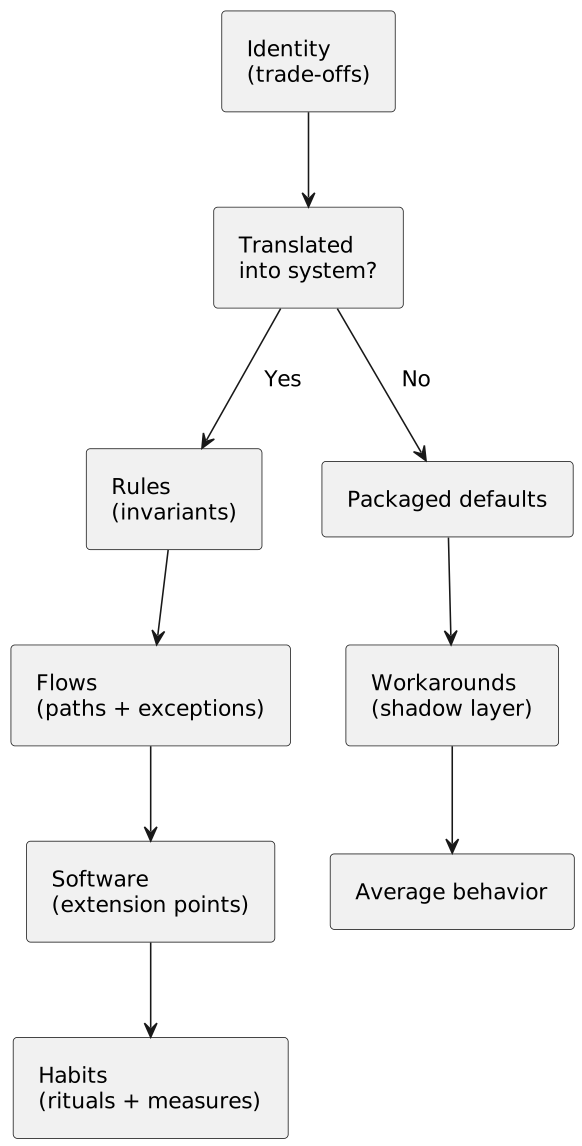
Without deliberate co-creation, software becomes a distant utility instead of an expression of how the organization thinks and works. Preserving singularity requires translating it into flows, rules, and components so it can survive leadership changes, market shifts, and technology upgrades.
This matters less when standardization is the strategy and differentiation is not a real constraint. It matters most when a few high-stakes moments define value and the system keeps averaging them away.
How to tell if uniqueness is present in the system
You can usually tell whether your singularity is present in software by how people talk about the systems they use every day — and by how often they need workarounds to “do it our way”.
Market. You hear variations of “we operate like everyone else” — and no one can point to where differentiation is encoded in flows, rules, or interfaces. That’s identity staying in discourse while the system trains a different behavior. A good first move is to map differentiators and prioritize unique experiences in a few key journeys.
Exceptions. Flows get cluttered with workarounds because the system can’t express real‑world variations that matter. That’s what it looks like when “identity → rules” never made it into the product. A practical way to start is to design extension and configuration points aligned with strategic differences.
Team. Teams don’t recognize themselves in the system — the language is foreign, the constraints feel arbitrary, and “doing it our way” requires parallel processes. That’s a translation gap, not a people problem. One simple move is to involve users in system design and measure perceived fit and usefulness.
Make uniqueness operational (not optional)
Suggested moves — pick one to try for 1–2 weeks, then review what you learned.
Locate where uniqueness creates value
Identify the journeys, decisions, and customer moments where “we do this differently” drives outcomes. This matters because uniqueness is not everywhere; it concentrates in a few high‑leverage flows.
Start with a 60‑minute workshop with business + tech to list three differentiators and the one or two journeys where they matter most. Watch whether stakeholders can point to a concrete workflow where uniqueness is visible (and where it is not).
Co-create the “uniqueness layer” in software
Co-design rules, screens, and extension points with the people who operate the work, so the system supports the real‑world variations that matter. This works because when the system can’t express real trade‑offs, workarounds become the operating model.
Start by picking one slice of one journey and building it end‑to‑end with weekly demos in the same room (business + tech). Watch whether exceptions and workarounds decline as the system starts to match reality.
Measure “fit”, not just delivery
Track time‑to‑value, adoption, and perceived fit (“does this system feel like us?”) for both customers and internal teams. This matters because if software is an organizational language, “fit” is a leading indicator of whether identity is translating into behavior.
Start by adding one simple fit question to retros and release reviews for 30 days. Watch for adoption without coercion and fewer “we can’t do this in the system” stories.
That standard gets easier to hold when you refuse to settle for ordinary.
Being unique is not just having a different slogan. It’s integrating people, processes, and technology into a distinctive way of generating value — and making that difference survive in daily operation.
If software never absorbs what makes the organization singular, differentiation erodes quietly. Teams adapt to generic flows, customers experience something similar to every other provider, and engagement declines. In the limit, systems that should protect what is extraordinary end up standardizing it — and it becomes harder to explain, even internally, what truly sets the company apart.
Which part of your software most needs to reflect what makes your company unique?