AI weakens judgment when internal models stop forming
AI can preserve output quality while quietly weakening the internal models people need for judgment and ownership.
When AI handles reasoning, structuring, and first drafts, people can deliver faster without building the cause-and-effect models that support real judgment. The risk is not lost productivity, but decision-making that cannot be explained, defended, or improved.
AI can preserve output while eroding judgment
Insight: AI does not just replace parts of knowledge work. It can also remove the learning loop through which people build the internal models needed for judgment, explanation, and ownership.
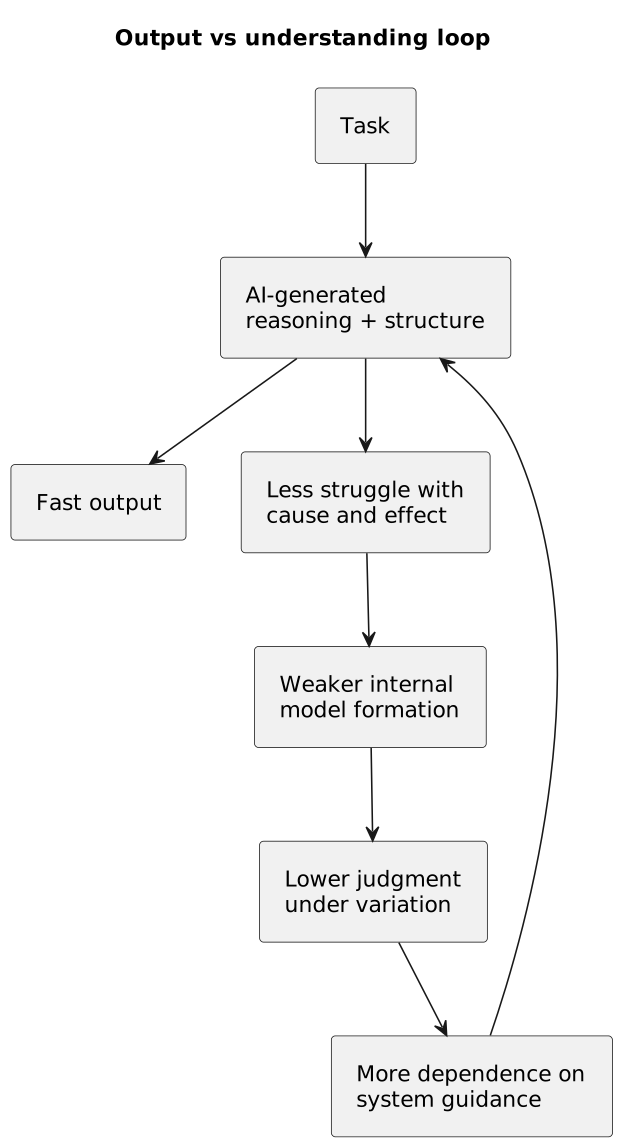
That is why the risk can stay hidden for a while. Teams still produce slides, analyses, user stories, code suggestions, and executive summaries. Throughput may even improve. On the surface, people still seem fully capable.
But outputs are not the same as understanding. What matters in real organizations is whether people can explain cause and effect, detect when something is off, defend a recommendation under pressure, and adapt when conditions change. Those abilities depend on an internal model: a working mental map of how the system behaves and why.
When AI handles the middle layer of the work, people can skip the struggle that usually builds that map. They frame the task, steer the tool, and polish the answer, but they spend less time wrestling with the mechanism itself.
The result is subtle: people often get better at delegation while getting worse at judgment. They can produce an answer, yet cannot fully explain why it should be trusted.
This happens because repeated use shifts effort away from model-building work and toward coordination work, so unused skills decay even while visible output remains high.
In one minute
- AI does not automatically make people less capable, but it does change which capabilities get exercised.
- When reasoning and first-draft structure move into the system, internal model formation can weaken before leaders notice any drop in output.
- Start with one critical workflow and ask a harder question than “did the work get done?”: can the person explain why the answer works, where it breaks, and what they would change?
Where the learning loop disappears
The pattern usually appears in a familiar scene. A manager asks for a recommendation memo, a product lead asks for a problem framing, or a team member needs to analyze a customer pattern. With AI, the first draft arrives faster and often sounds more complete than what a junior person would have produced alone.
That speed is useful, but it changes the developmental path. In the old loop, people had to sort weak signals, form a hypothesis, organize the argument, notice gaps, and revise their thinking. The draft was not just an output; it was the exercise that built understanding.
In the new loop, the person may jump from a rough prompt to a polished draft. They still choose, edit, and approve, but much of the intermediate reasoning is no longer theirs. They are working around the model instead of through it.
A leadership team usually notices this only later, when the conversation turns. Someone asks, “Why did we choose this?” or “What would make this recommendation fail?” and the person who produced the work cannot reconstruct the logic with confidence.
That is the practical signal. The work exists, but ownership is thin because the internal model never fully formed.
This is less concerning when the task is low-stakes, heavily standardized, or mainly editorial. It becomes serious when the work depends on diagnosis, trade-off reasoning, exception handling, or choices that must be defended across functions.
Internal models are what make skill real
By internal model, I mean the cause-and-effect understanding a person builds through doing the work: what variables matter, which trade-offs are real, what failure modes to expect, and how to tell whether the answer fits the situation.
That model is what supports judgment. Without it, a person can approve a result without being able to challenge it, adapt it, or own its consequences.
The mechanism is straightforward:
- AI reduces the cost of producing a plausible first answer, structure, or recommendation.
- When people rely on that shortcut repeatedly, they practice less of the reasoning that normally builds internal models.
- Skill does not disappear, but more of it moves into the human-plus-system combination instead of remaining in the human alone.
This does not mean AI is inherently harmful. The problem is not use; it is unexamined substitution. If teams deliberately redesign work so people still have to explain mechanisms, test assumptions, and handle exceptions, AI can accelerate learning instead of bypassing it.
It also helps explain why AI automation stays fragile when intent isn’t portable. If people never build the internal model behind a decision, they struggle to make that intent explicit enough for other teams, new hires, or AI systems to carry it reliably.
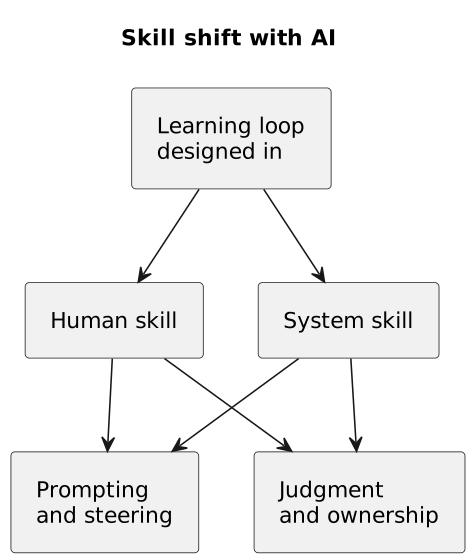
The reframe is important: the real question is not whether people are “getting worse”. It is which skills the organization is letting decay, and which ones it is intentionally redesigning for the AI era.
Signals internal models are getting weaker
You can see this pattern in review meetings, handoffs, onboarding, and exception handling. Weak internal models leave behavioral fingerprints long before output quality fully drops.
People can edit answers they cannot explain. The output looks polished, but when asked to defend the logic, the explanation collapses into “the model suggested it” or generic phrases. Start by adding one review question to important workflows: what is the mechanism behind this recommendation, and what evidence would falsify it?
Teams escalate basic exceptions too early. Routine variation quickly turns into “can you review this for me?” because people do not have a reference model for where the default breaks. Start by tracking which exceptions repeatedly require senior intervention and whether the issue is knowledge access or missing understanding.
Onboarding gets faster, but independent judgment does not. New hires become productive in tooling quickly, yet still struggle to make decisions without AI assistance or senior confirmation. Start by measuring time to independent reasoning, not just time to first output.
Ownership gets fuzzy in cross-functional forums. Someone produced the memo, analysis, or plan, but no one can fully defend the assumptions when challenged by finance, operations, architecture, or legal. Start by watching how often important decisions are revisited because the original rationale was shallow or non-transferable.
Quality looks stable until context changes. Work seems fine in familiar cases, then breaks when stakes rise, assumptions shift, or edge cases appear. That is often a model-formation issue, not just an execution issue. Start by reviewing where performance drops most sharply under variation.
Redesign work so understanding still gets built
Suggested moves, not mandates. Pick one critical workflow and test it for 1–2 weeks.
Separate AI-assisted output from human explanation
Keep AI in the workflow, but require the person responsible for the work to explain the mechanism, trade-offs, and likely failure modes in their own words before approval. Ownership becomes visible only when explanation is possible. Start with one recurring document, such as a recommendation memo or discovery summary. Add a short “why this works / where it breaks” review step, then watch whether explanations get sharper over two weeks or stay dependent on the original prompt.
Protect a few model-building reps on purpose
Do not automate every middle step for developing roles. Choose a small number of tasks where people must still frame the problem, generate a first hypothesis, and compare it against AI output afterward. This works because judgment is built through contrast and correction, not just exposure to polished answers. Start with one decision type that matters to your business and run paired practice for two weeks. Watch whether people spot flaws earlier and ask better questions of the tool.
Redefine skill metrics beyond throughput
If you only measure speed, volume, and document completion, you will reward delegation while missing judgment decay. Add simple signals for explanation quality, exception handling, and confidence under challenge in one team ritual. This works because what gets measured shapes which skills survive. Start by adding one scorecard line to review meetings: can the owner explain the causal model, boundary conditions, and next adjustment without leaning on the generated draft? Watch whether rework under changed conditions goes down.
AI will keep taking on more of the structuring and reasoning layer of work because that is exactly where much of the economic value sits. The mistake is to assume that if output remains strong, human skill remains intact.
In knowledge work, skill is not only what gets produced. It is also the internal model that lets someone detect errors, explain trade-offs, and take responsibility when the answer meets reality. If that model no longer forms, ownership turns thin. People still ship work, but they cannot fully defend it.
The strategic move is not to resist AI, but to redesign learning loops around it. Use the system to accelerate work, but be explicit about which human skills must still be exercised, tested, and kept alive.
Which skill in your organization still looks productive with AI support, but is quietly losing the internal model behind it?